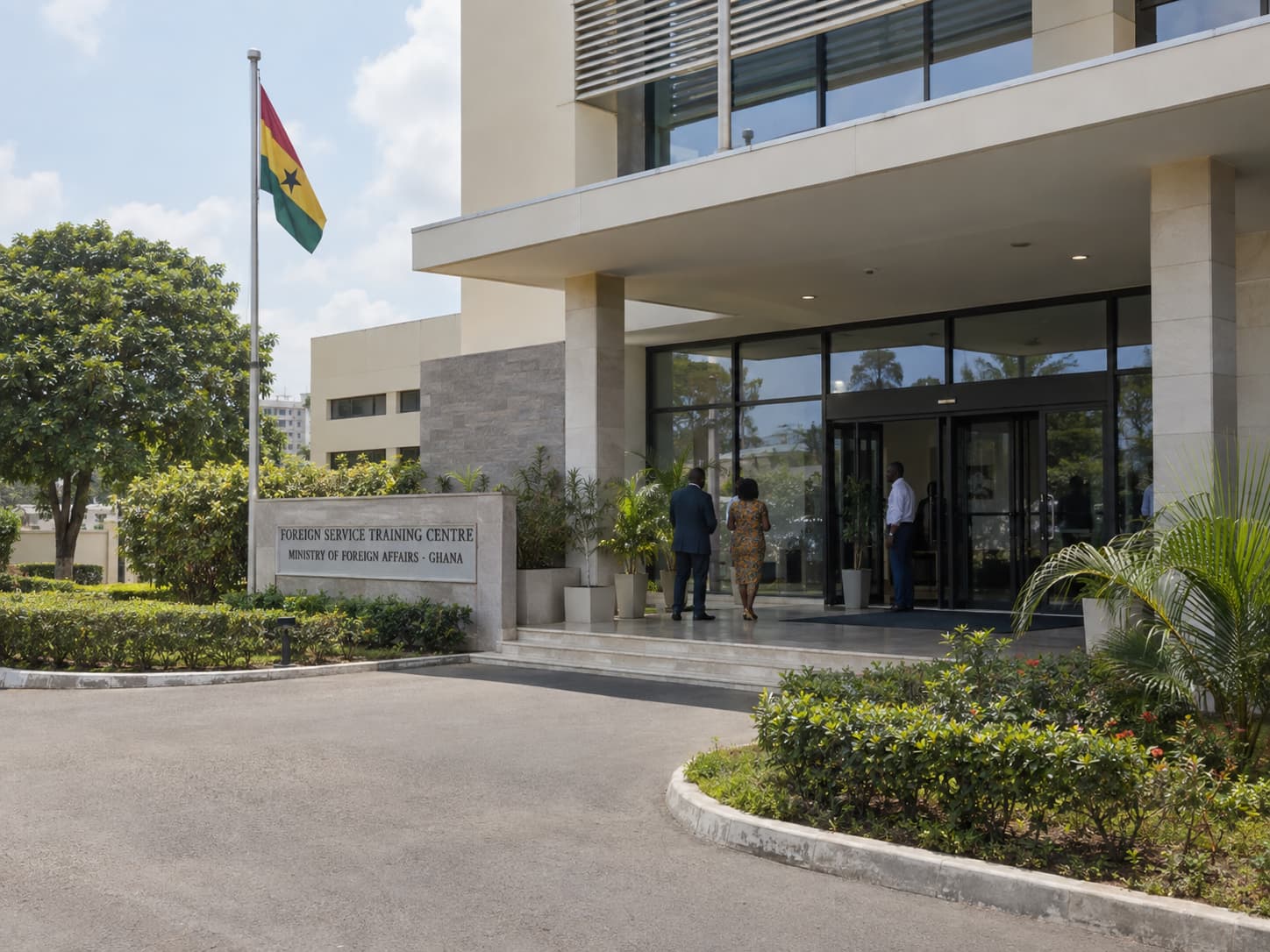
A career in Ghana’s Foreign Service can eventually lead to work in an embassy, high commission or consulate thousands of kilometres from Accra. Before that happens, however, a new officer has to enter the public service system, understand how the Ministry of Foreign Affairs operates and develop practical diplomatic skills. The path is not simply a matter of earning a degree and applying for an embassy job. It involves selection, professional preparation, experience at headquarters and, for some officers, eventual assignment to one of Ghana’s missions abroad.
Entering Ghana’s public service
The first stage is recruitment. Ghana does not use one permanent recruitment procedure for every Foreign Service position, so requirements depend on the vacancy being advertised. Candidates generally need to meet the academic and professional conditions specified for the position and pass the relevant stages of selection.
Recruitment into Ghana’s public service can include assessment of qualifications, examinations or interviews, depending on the role. Applicants must also satisfy the general eligibility requirements applied to public-sector employment. This means that anyone interested in diplomatic work needs to follow official vacancies rather than assume that an unsolicited application to an embassy will begin the process.
Academic background matters, but there is no single degree that automatically produces a diplomat. International relations, political science, law, economics and languages can all be relevant, while other areas may be useful for specialised work. Ghana’s diplomatic service deals with far more than traditional political negotiations, so people with different professional backgrounds can contribute to its work.
Skills needed beyond a university degree
Diplomatic work requires a combination of analytical, administrative and communication skills. Foreign Service officers may prepare reports, follow political and economic developments, organise official visits, work with international organisations, assist Ghanaian citizens abroad or support discussions involving trade and investment.
Clear writing is particularly important because much of diplomatic work involves producing concise information for other officials. An officer may need to summarise a political development in the host country, prepare briefing material for a meeting or explain the implications of a new local policy.
Communication skills are equally important. Diplomats regularly deal with officials, businesses, universities, civil society groups and members of the Ghanaian diaspora. Knowing how to speak confidently is useful, but listening carefully, understanding cultural differences and maintaining professional relationships can be just as important.
Language ability can also strengthen a candidate’s profile. English is the official working language of Ghana, but knowledge of additional languages can become valuable when an officer is assigned to a country where another language dominates government, business or everyday life.
Learning how the Ministry works
Joining the Foreign Service does not mean immediately leaving Ghana for an overseas mission. Experience at the Ministry of Foreign Affairs in Accra is an important part of understanding how Ghanaian diplomacy functions.
The Ministry contains departments and units covering areas such as political relations, economic diplomacy, consular affairs, protocol, legal matters, public communication, diaspora relations and international organisations. Working within this structure allows new officers to see how information from Ghana’s missions abroad reaches headquarters and how foreign-policy decisions are communicated back to those missions.
This stage also introduces officers to the administrative side of diplomacy. Official correspondence, reporting procedures, protocol and coordination between different departments may appear less visible than international meetings, but they are essential to the functioning of a diplomatic service.
For a new officer, headquarters experience provides a foundation that becomes particularly valuable later. Understanding how decisions are made in Accra makes it easier to represent those decisions accurately when working abroad.
Professional training for diplomats
Ghana also has a Foreign Service Institute that provides professional training for diplomats and other officials working in international affairs. Its role is to develop skills that are difficult to gain from academic education alone.
Training can cover areas such as negotiation, diplomatic protocol, international law, economic diplomacy, communication and global governance. Officers can also receive preparation related to the political and cultural environment in which they may eventually work.
The difference between university education and diplomatic training is important. A graduate may know the theory of international relations but still need to learn how to prepare an official diplomatic note, organise a high-level visit or take part in negotiations representing the state.
Professional development therefore continues after recruitment. Diplomacy changes with technology, international trade, security challenges and new forms of communication, so officers have to keep updating their skills throughout their careers.
Preparing for the first overseas posting
An overseas appointment is a major step in a Foreign Service career. Before leaving Ghana, officers selected for foreign assignments can receive additional orientation designed specifically for work at diplomatic missions.
Recent preparation programmes have included diplomatic practice, negotiation, protocol, economic diplomacy, investment promotion, digital diplomacy, budgeting and personal wellbeing. This range of subjects reflects the reality of modern embassy work.
A diplomat posted overseas may have to move between very different responsibilities. One day can involve preparing a briefing about local political developments, while another may focus on a Ghanaian business delegation, a cultural event or assistance to citizens. Administrative responsibilities remain part of the job as well.
Preparation also helps officers understand that serving abroad involves representing Ghana in everyday interactions, not only during formal ceremonies. Professional behaviour, knowledge of the host country and an ability to adapt to unfamiliar situations all become part of the assignment.
Life at a Ghanaian mission abroad
The character of a first posting depends heavily on the country and the size of the mission. Ghana maintains embassies, high commissions, consulates and other diplomatic representations in different regions of the world.
At a large mission, responsibilities may be divided among political, economic, consular and administrative sections. At a smaller mission, officers may have to work across several areas at once. This can give junior diplomats broad practical experience early in their careers.
Much of the job happens away from cameras. Officers write reports, maintain contacts with local institutions, arrange meetings, support senior diplomats and monitor developments that may affect Ghana’s interests. They may also work with Ghanaian communities abroad or help organise visits by government representatives.
For a new diplomat, the first posting is therefore not the end of training. It is another stage of learning, this time in a foreign environment where mistakes and successes have more immediate practical consequences.
Building a diplomatic career
Foreign Service careers usually develop through a combination of headquarters assignments and work abroad. An officer may return to Accra after one mission, take on a different responsibility at the Ministry and later be posted to another country.
Each assignment provides a different type of experience. A diplomat who has worked on consular issues may later move into economic diplomacy. Someone who has served in one region may eventually work in another with a very different political and cultural environment.
Ghana also uses the experience of senior and retired diplomats to help younger officers understand the profession. Informal knowledge matters because many diplomatic situations cannot be reduced to written rules. Learning how experienced officials handled negotiations, crises or difficult relationships can complement formal training.
A career in Ghana’s Foreign Service therefore begins long before an officer takes up a position at an embassy. It starts with recruitment into public service, continues through work and professional training in Accra and gradually leads to greater responsibility. The first overseas posting is an important milestone, but it rests on years of preparation, learning and adaptation. For anyone interested in representing Ghana abroad, understanding this process is as important as the image of diplomacy itself.